Crypto Toolbox Talk
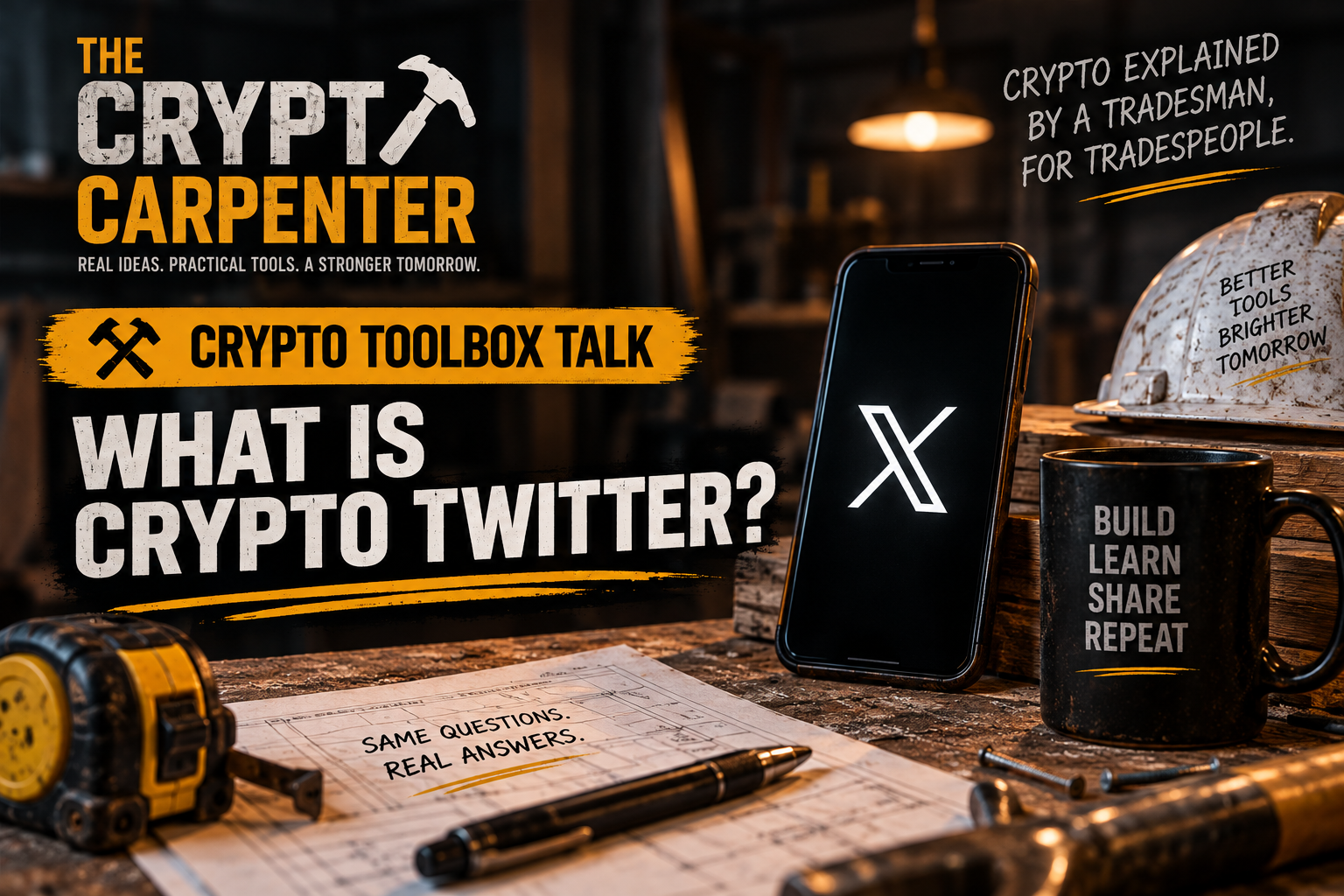
Crypto Toolbox Talk: What Is Crypto Twitter?
Crypto Twitter isn't another app. It's the crypto conversation happening on X — and it can be useful, noisy, educational, misleading, and everything in between.
Someone asked me a question recently that sounded simple:
What is Crypto Twitter?
And I'll admit, it made me stop for a second.
I've been interested in crypto for years. I've followed projects, watched markets, used exchanges, experimented with wallets, and spent plenty of time reading crypto posts online.
But when people said "Crypto Twitter" or "CT," was there actually something more to it?
A separate platform? A special community you join? Some corner of the internet I had somehow missed?
Nope.
Crypto Twitter is simply the name people use for the crypto community and conversation happening on X, formerly Twitter.
That's it.
But knowing what it is and knowing how to use it are two very different things.
Think of it like the break area on a huge jobsite
Here's probably the easiest way I can explain Crypto Twitter to another tradesperson:
Think of Crypto Twitter like the break area on a huge jobsite.
You'll hear some really useful information, plenty of opinions, a few arguments, and at least one guy who acts like he knows everything.
Somebody may know exactly what they're talking about.
Somebody else heard something from a guy who heard it from another guy.
And somebody is probably trying to sell you something.
Crypto Twitter isn't much different.
The difference is that instead of a dozen people standing around at break, you're listening to thousands of people from around the world.
So there's no actual "Crypto Twitter"?
Correct.
There isn't another Crypto Twitter app to download.
There's no CT membership.
There's no button on X that says Join Crypto Twitter.
It's simply an informal name for the part of X where people talk about Bitcoin, cryptocurrency, blockchain technology, markets, regulation, wallets, exchanges, DeFi, NFTs, stablecoins and just about everything else connected to crypto.
You'll often see people abbreviate it as CT.
When someone says:
"CT is going crazy today."
They're basically saying:
"The crypto crowd on X is going crazy today."
And if you've spent any time around crypto, you already know that can happen pretty often.
Who is actually on Crypto Twitter?
Pretty much everyone connected to the industry in some way.
You'll find:
A good rule of thumb:
If a stranger approaches you online about your crypto or your wallet, your guard should immediately go up.
And never give anyone your seed phrase or private keys.
Use CT as a starting point, not the final answer
This may be the most important part of the whole Toolbox Talk.
Crypto Twitter can be an excellent place to discover information.
It shouldn't automatically be the place where you verify information.
If someone posts that an exchange changed a policy, go check the exchange's official announcement.
If someone says a project released an important update, look at the project's official documentation or announcement.
If someone claims a new law or regulation changed something, find the government or regulatory source.
Think about it the same way you would on a jobsite.
If somebody tells you the architect changed an important detail, you don't rebuild the wall because you heard about it at break.
You check the drawings.
Crypto should be treated the same way.
🔨 Toolbox Takeaway
Crypto Twitter — or CT — isn't a separate platform.
It's simply the crypto community and conversation happening on X.
It can be one of the fastest ways to discover what's happening in crypto, learn from knowledgeable people and find new ideas.
It can also be noisy, biased, promotional and full of scams.
So use it like information you hear on a jobsite:
Listen. Ask questions. Learn who knows their stuff. And verify the important things before you act on them.
That's really what this new Crypto Toolbox Talk series is going to be about.
I'm a tradesman who's been interested in crypto for years, but I still have questions myself. When I run across one, I'm going to dig into it and try to explain what I learn in normal language — without pretending crypto needs to be more complicated than it is.
Crypto explained by a tradesman, for tradespeople.
Next Toolbox Talk:
How Do You Actually Set Up Crypto Twitter?
We'll start with a normal X account and look at how to turn it into a useful crypto resource without filling your toolbox with junk.
What is Crypto Twitter?
And I'll admit, it made me stop for a second.
I've been interested in crypto for years. I've followed projects, watched markets, used exchanges, experimented with wallets, and spent plenty of time reading crypto posts online.
But when people said "Crypto Twitter" or "CT," was there actually something more to it?
A separate platform? A special community you join? Some corner of the internet I had somehow missed?
Nope.
Crypto Twitter is simply the name people use for the crypto community and conversation happening on X, formerly Twitter.
That's it.
But knowing what it is and knowing how to use it are two very different things.
Think of it like the break area on a huge jobsite
Here's probably the easiest way I can explain Crypto Twitter to another tradesperson:
Think of Crypto Twitter like the break area on a huge jobsite.
You'll hear some really useful information, plenty of opinions, a few arguments, and at least one guy who acts like he knows everything.
Somebody may know exactly what they're talking about.
Somebody else heard something from a guy who heard it from another guy.
And somebody is probably trying to sell you something.
Crypto Twitter isn't much different.
The difference is that instead of a dozen people standing around at break, you're listening to thousands of people from around the world.
So there's no actual "Crypto Twitter"?
Correct.
There isn't another Crypto Twitter app to download.
There's no CT membership.
There's no button on X that says Join Crypto Twitter.
It's simply an informal name for the part of X where people talk about Bitcoin, cryptocurrency, blockchain technology, markets, regulation, wallets, exchanges, DeFi, NFTs, stablecoins and just about everything else connected to crypto.
You'll often see people abbreviate it as CT.
When someone says:
"CT is going crazy today."
They're basically saying:
"The crypto crowd on X is going crazy today."
And if you've spent any time around crypto, you already know that can happen pretty often.
Who is actually on Crypto Twitter?
Pretty much everyone connected to the industry in some way.
You'll find:
- Bitcoin and crypto enthusiasts
- Developers and builders
- Crypto companies and exchanges
- Project founders
- Researchers and analysts
- Journalists
- Traders
- Investors
- Educators
- Regulators and policymakers
- People who are simply trying to learn
- Random DMs offering investment opportunities
- People claiming they can recover lost crypto
- Fake giveaways
- Impersonation accounts
- Links asking you to connect a wallet
- "Guaranteed" returns
- Urgent messages telling you to act immediately
- Anyone asking for your seed phrase or private keys
You'll also find promoters, bots, fake accounts and scammers.
That's why CT can be incredibly useful and incredibly misleading at the same time.
Why do people use it?
One of Crypto Twitter's biggest strengths is speed.
When something important happens in crypto, there's a good chance people are discussing it on X almost immediately.
A company launches something.
A network has a problem.
New legislation gets introduced.
An exchange changes a policy.
A developer announces an update.
Bitcoin makes a major move.
The conversation starts quickly.
That makes X useful for discovering what's happening and finding people who understand a particular subject.
But there's an important distinction:
Fast information isn't automatically accurate information.
A post getting thousands of likes doesn't make it true.
A person having 500,000 followers doesn't make every opinion correct.
And someone posting a screenshot of a huge trading gain definitely doesn't mean you should copy the trade.
The algorithm matters too
Your Crypto Twitter experience isn't going to look exactly like mine.
X learns from what you follow, click, like, reply to and spend time reading.
If you constantly interact with thoughtful educational content, you're more likely to see more of it.
If you constantly interact with price predictions, meme coins and posts promising the next 100x opportunity, you're probably going to see a lot more of that instead.
That's an important lesson for someone getting started.
You're helping build the feed you're going to receive.
We'll get much deeper into that in the next Toolbox Talk.
Where beginners can get into trouble
Crypto already involves money, and wherever money is involved, scammers aren't far behind.
Crypto Twitter is no exception.
Be especially cautious with:
A good rule of thumb:
If a stranger approaches you online about your crypto or your wallet, your guard should immediately go up.
And never give anyone your seed phrase or private keys.
Use CT as a starting point, not the final answer
This may be the most important part of the whole Toolbox Talk.
Crypto Twitter can be an excellent place to discover information.
It shouldn't automatically be the place where you verify information.
If someone posts that an exchange changed a policy, go check the exchange's official announcement.
If someone says a project released an important update, look at the project's official documentation or announcement.
If someone claims a new law or regulation changed something, find the government or regulatory source.
Think about it the same way you would on a jobsite.
If somebody tells you the architect changed an important detail, you don't rebuild the wall because you heard about it at break.
You check the drawings.
Crypto should be treated the same way.
🔨 Toolbox Takeaway
Crypto Twitter — or CT — isn't a separate platform.
It's simply the crypto community and conversation happening on X.
It can be one of the fastest ways to discover what's happening in crypto, learn from knowledgeable people and find new ideas.
It can also be noisy, biased, promotional and full of scams.
So use it like information you hear on a jobsite:
Listen. Ask questions. Learn who knows their stuff. And verify the important things before you act on them.
That's really what this new Crypto Toolbox Talk series is going to be about.
I'm a tradesman who's been interested in crypto for years, but I still have questions myself. When I run across one, I'm going to dig into it and try to explain what I learn in normal language — without pretending crypto needs to be more complicated than it is.
Crypto explained by a tradesman, for tradespeople.
Next Toolbox Talk:
How Do You Actually Set Up Crypto Twitter?
We'll start with a normal X account and look at how to turn it into a useful crypto resource without filling your toolbox with junk.